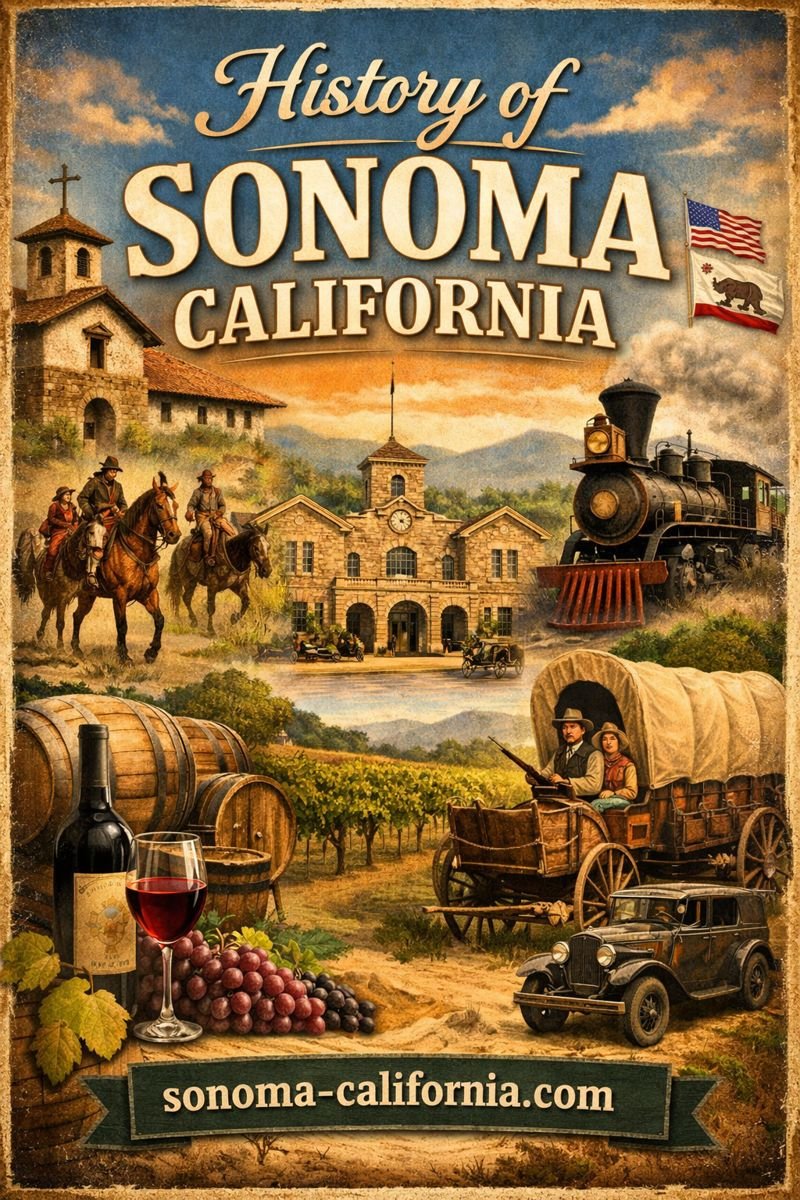
History of Sonoma, California
Birthplace of the California Republic & the California Wine Industry
Quick Facts About Sonoma
Ancient Beginnings
Long before European settlers arrived, the Sonoma Valley was home to indigenous peoples for over 12,000 years. Native American tribes including the Pomo, Wappo, and Miwok inhabited the region, with the Miwok particularly prominent in the area. The name “Sonoma” is believed to derive from indigenous origins—possibly from a Wintun word for “nose” referring to a local chief, or from the Wappo word “tso-noma” meaning “earth village” or “redwood place.”
The valley was also known by its poetic name “Valley of the Moon,” a designation later popularized by author Jack London in his 1913 novel of the same name. Legend suggests the name comes from an indigenous word meaning “many moons,” though the true origin remains a topic of historical debate.
The Mission Era & Mexican Rule
1823 The history of modern Sonoma began when Padre José Altimira established Mission San Francisco Solano under the direction of Governor Luis Antonio Argüello. This was the 21st and final mission in California’s famous mission chain—and notably, the only mission founded under Mexican rather than Spanish rule. Mexico had gained independence from Spain in 1821 and sought to strengthen its presence in the region to deter Russian expansion from Fort Ross on the coast.
1835 Following the Mexican secularization of the missions, General Mariano Guadalupe Vallejo founded the town of Sonoma on the former mission lands. Vallejo laid out the streets and the famous Sonoma Plaza in accordance with Spanish Laws of the Indies, creating what would become the heart of the city. At his height, Vallejo controlled a private estate of over 175,000 acres and served as Military Commander of the Northern Frontier.
The Sonoma Barracks were constructed to house Mexican troops, establishing Sonoma as a military outpost protecting Mexican interests against both Russian encroachment from Fort Ross and the growing number of American settlers arriving in California.
🏴 The Bear Flag Revolt
June 14, 1846 Sonoma became the birthplace of the short-lived California Republic when a group of approximately 33 American settlers, led by William B. Ide and Ezekiel Merritt, captured the Mexican garrison without firing a shot. They surrounded General Vallejo’s home and demanded his surrender—ironically, Vallejo himself was sympathetic to American annexation and invited the rebels in for breakfast and wine.
Birth of the California Republic
The rebels declared California an independent republic and raised the famous Bear Flag over Sonoma Plaza. The flag, created by William Todd (a cousin of Mary Todd Lincoln), featured a grizzly bear and red star on a white background with the words “California Republic” beneath. The insurgents called themselves “Los Osos” (The Bears) and their uprising became known as the Bear Flag Revolt.
The California Republic lasted only 25 days. On July 7, 1846, U.S. Navy Lieutenant Joseph Revere arrived in Sonoma and raised the American flag in front of the Sonoma Barracks, officially bringing the republic to an end. Though brief, the Bear Flag’s legacy endures—it became the official State Flag of California in 1911 and remains so today.
1850 California was admitted as the 31st state in the Union on September 9, 1850. Sonoma was named the first county seat for Sonoma County, though this distinction was later transferred to Santa Rosa in 1854 as surrounding towns grew more rapidly.
Birthplace of California Wine
Sonoma’s wine heritage dates back to the mission era. In 1823, Padre José Altimira planted the first grapevines at Mission San Francisco Solano, establishing the foundation for what would become one of America’s most celebrated wine regions. By 1824, approximately one thousand grapevines were growing at the mission.
General Vallejo continued the tradition, cultivating his own wines and becoming known for profitable grape production. However, it was a Hungarian immigrant who would transform Sonoma into a world-renowned wine destination.
1857 Count Agoston Haraszthy arrived in Sonoma Valley and purchased the Vallejo vineyard, renaming it Buena Vista—which still operates today as the oldest continuously operating winery in California. In 1861, Haraszthy was commissioned by the California legislature to study European viticulture. He returned with over 100,000 cuttings representing more than 350 grape varieties, revolutionizing California winemaking and earning the title “Father of the California Wine Industry.”
Haraszthy also pioneered the use of Chinese immigrant laborers in the wine industry, hiring them to work the vineyards, expand cellars, and construct winemaking facilities. The contributions of these workers were essential to building Sonoma’s early wine infrastructure.
Notable Historical Figures
General Mariano Guadalupe Vallejo
Founder of Sonoma (1835)
Mexican military commander who founded the town of Sonoma and laid out the famous plaza. His restored home is now part of Sonoma State Historic Park.
Agoston Haraszthy
“Father of California Viticulture”
Hungarian count who founded Buena Vista Winery and introduced hundreds of European grape varieties to California, transforming the wine industry.
Jack London
Author & Adventurer
The famous author lived and wrote at his Beauty Ranch in nearby Glen Ellen, coining Sonoma Valley’s nickname “The Valley of the Moon” in his 1913 novel.
Sonoma Today
The City of Sonoma was officially incorporated on September 3, 1883, and continues to honor its rich history while embracing modern times. The historic Sonoma Plaza—the largest plaza in California—remains the heart of the community, surrounded by adobe buildings, tasting rooms, and restaurants. Mission San Francisco Solano, restored in 1914 after earthquake damage, is now part of Sonoma State Historic Park.
Today, Sonoma County is home to over 750 wineries and more than 50,000 acres of vineyards with 60 different grape varieties. The wine and tourism industries contribute approximately $11 billion annually to the local economy. With its blend of California history, world-class wines, and natural beauty, Sonoma continues to attract visitors from around the world who come to experience the birthplace of both the California Republic and the California wine industry.
Need a Website That Stands Out?
Professional web development and digital marketing solutions for businesses ready to grow online. From WordPress websites to local SEO, we help you get found.
Visit TIV360.comWordPress Development • Local SEO • Digital Marketing • Business Directories
Sources: Sonoma State Historic Park, Sonoma County Tourism, U.S. Census Bureau, California State Parks
Sonoma, California – Where History and Wine Country Meet